Arts and Punishment

Aug 26
2010

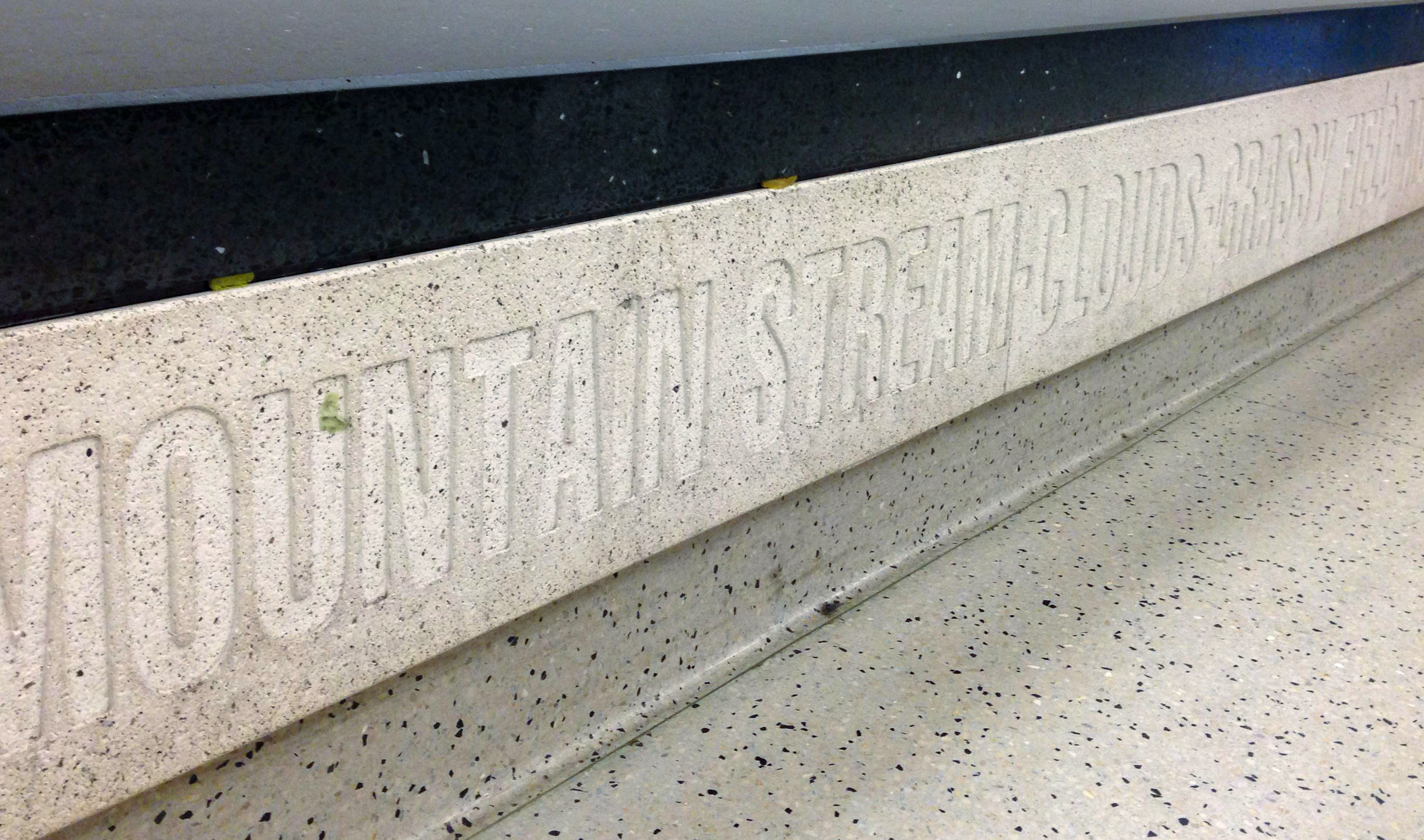
Smooth slabs of flecked marble. Slate gray walls. Arched ceilings. Ax murderers?

The recently opened Dostoevsky Station in the Moscow subway has all of that, and more.

One of a series of metro stations named after Russian literary heroes, Dostoevskaya features murals that depict scenes from his famous novels such as Brothers Karamazov, The Idiot and Crime and Punishment, as well as a stern portrait of Fyodor himself.

The wall art is austere, featuring black and white silhouettes of the books’ characters in action: a man is raising a gun to his head. Another holds an ax above his, waiting to bring it down on a women nearby. Read the rest of this entry »

Jello, Good-Bye

Jul 26
2010

Drinking and environmentally sound items are two of our favorite things.

Summer is a time for cocktails and lemonade on the lawn or deck, not doing dishes.

Happily, the designers at THE WAY WE SEE THE WORLD have come up with a solution to the paper vs. plastic debate.

Jelloware cups are made of agar, cast in an assortment of flavors and colors.

Yes, agar-agar is that substance you used in bio lab to grow bacteria on petri dishes. But that’s because it’s completely organic, made from algae.

It’s also been a common ingredient in Asian desserts for quite some time, and is a staple of modern cooking techniques.

Jelloware cups come in lemon-basil, ginger-mint, or rosemary-beet, and are completely edible and biodegradable.

When you’re done with your drink, chomp on your chalice, or just tear it to bits and sprinkle it on the lawn: agar actually nurtures the growth of plants.

High heat or high alcohol content may make for a relatively short lifespan, so be sure to drink up!

Concept photos from the 2nd annual Jell-O Mold Competition have recently made the blog rounds, but there’s no purchase link to be found. Anyone know how to get?

[via @brainpicker and @treehugger]

Blade Switch

Jul 18
2010

Kyocera Corporation makes solar cells, telecommunications equipment, semiconductor packages and dental implants, among other products.

The common thread? Ceramics.

For the retail consumer, advanced ceramics offers ultra-sharp, precise kitchen knives.

Unlike metal, ceramic blades (usually made from zirconia) will never rust, and their edge will stay sharp up to ten times longer than steel.

Chemical inertness makes them impervious to smells and stains.

Additionally, ceramic weighs much less than metal, resulting in a knife that is easy to wield with precision.

On the other hand, some feel they are more trouble than they are worth.

Sharpening can only be accomplished with diamond-based sharpeners, and the blade is extremely brittle.

The knife will shatter like glass if dropped on a hard surface. Attempting to cut through bone or frozen materials can cause splintering. Using the knife in a twisting or prying motion can cause it to snap.

Black blades that have gone through an extra hot firing process are somewhat tougher (and very elegant).

Though more expensive than traditional knives, the accuracy of ceramic knives makes them downright fun to use.

And at only $25, there’s no excuse to skip the mandoline for easy homemade potato chips.

Summer Swing

Jun 30
2010

It’s summer in the USA!

Whether you’re relaxing on the beach or just on the lawn, the Yosemite Valley Gear foldable hammock is bound to make you smile.

The steel frame is light but strong, and the nylon hammock attaches with easy-swinging hooks (touted as “high-grade Japanese bearings”) at each end.

Best of all, assembly is easy. And not “Ikea easy,” but actually simple.

If you can uncork a bottle of wine, you’ll be able to set this baby up in under 5 minutes.

This $60 accessory is perfect for carrying to the shore instead of a beach chair.

Great if you’re trapped indoors working and want to spend your lunch hour truly relaxing on your roof or deck.

Or maybe even — on late summer evenings when stomachs are full and brains are buzzing — for unexpected house guests.

h/t @toofeets, bottom photo by @phillygrrl

Direct Connect

Jun 23
2010

We recently had the opportunity to do an aerial photo shoot for Vanguard Energy Partners, a New Jersey-based company that manufactures and installs solar electric systems.

Among the subjects we photographed were:

A home, a farm, a high school, a municipal EMS building, a bank, a shopping mall, a courthouse, a warehouse and even a federal prison.

We also saw several other examples along the way.

Photo-voltaic cells are arranged in solar panels that live on rooftops and are connected to the structure’s main electrical panel.

Energy is produced when the sun shines down and is converted into alternating current that is fed into the building’s power supply.

Solar panels are not new, but installation and use of these systems is on the rise around the world.

Germany leads the pack in wattage produced per capita, which is three times the number for Japan, and more than 15 times the per capita amount in the US.

Not only is this the most environmentally friendly way to produce electricity for a home or facility, it’s also cost-effective, greatly reducing electric bills.

You can even earn rebates on utility bills when any excess energy is produced — it’s sent back out into the main power grid. Federal and state tax credits help offset the initial cost of installation.

Seeing these installations all over the place — on all kinds of structures — was refreshing.

All of our energy comes originally from the sun, but solar panels allow us to capture it without a lot of polluting and wasteful intermediary steps.

Sun → electricity.

Instead of sun → plants → dinosaurs → petroleum → steam → electricity.

A direct connect.

[photos by Mark Henninger]

Design in Play

Jun 14
2010

Smooth wood. Primary colors. Fundamental shapes. Meet Naef play objects.

The beauty of these Swiss-made toys lies in their relative simplicity: interlocking shapes that can be rearranged and stacked into infinite patterns.

Seemingly basic pieces allow children to explore the physics and visual cues of our world, having fun as they discover new relationships of shape and color.

The elementary designs leave room for the imagination to roam, uninhibited by a connected brand or cartoon story.

Adults hands will be itching to play, too. The array of available configurations sparks thoughts of malleable table art.

Indeed, the price tag on many of the items suggests more artwork than plaything, with averages between $150 – $300 per set.

Famous Swiss workmanship does go into each piece: most are handcrafted and quality-inspected to within a millimeter.

Also worth noting is that each knickknack was created by a specific designer, including authorized replicas by original Bauhaus members.

There’s even an annual contest held to find creative new arrangements for certain sets, held in Japan, where Naef has had a strong presence for decades.

In 2005 Naef USA was launched in Winchester, Virginia and is going strong. Perhaps we’ll see greater spread of these decidedly un-quotidian blocks here in the near future.

Getting There

Jun 04
2010

On first glance, it’s not easy to tell that these are all photos of the same building.

This private art gallery in the Philadelphia suburbs was designed to look different from each and every angle. And to have a certain ambiance when morning sun strikes it, one that is distinct from when the sun is beaming down overhead, and different still from that on a gray day.

Each glass panel of the wall is a different shape. Each of the wood-like slats that cover one side tapers outward, changing in width.

Even the greenery of the surrounding lawn has been designed in irregular patches of flower and grasses, blooming and sprouting in different shapes as the seasons progress.

Yet the gallery also performs at its intended function, showcasing artworks without exposing them to direct sunlight. An asymmetric wire mesh drapes in artful curves over a wireframe beneath the high ceiling; the structure will allow for artworks to hang in almost any configuration.

Spend a few minutes talking to John Shields, and you get the impression he’s a dreamer. But his firm, point b, has had great success in putting inventive design ideas into practice. Read the rest of this entry »

Topsy Turvy Chess

May 23
2010

Who said chess had to be staid?

Designer Adin Mumma‘s surprisingly elegant Wobble Chess Set adds a touch of whimsy to the serious game.

The maple and walnut pieces are finished with rounded chrome zinc bottoms that sway when placed in the concave spots on the polished wooden board.

Many will recognize the inspiration for the set’s design as the Weebles, Hasbro’s roly-poly toys that were common in the 1970s. “Weebles wobble, but they won’t fall down!”

Unusual chess sets abound, from one etched from Waterford Crystal to LEGO playing pieces to Givan’s custom-constructed vertical board, found in high-profile venues such as Jay-Z’s 4040 Clubs.

In adding quivering motion to this refined pastime, Mumma has created something new. Thoughts of Lewis Carroll cannot be far behind.

[via Little Clock Shop]

Hide Your Cars

May 14
2010

Above ground, the people live. Below, the cars.

The parking robots are coming.

Over the past decade, automated parking systems have become quite common in Europe and Asia, where land use constraints are tighter and many areas more congested than the US.

Automated parking systems can fit up to 20 cars in the footprint that would traditionally house just four.

The number of automobiles produced worldwide may actually be on the decline, but we still crank out over 50 million cars each year.

Along with the new trend of “bright flight“, American city developers are feeling the capacity crunch, and auto-auto-lots have begun to appear here as well.

Although the first of these facilities — built in Hoboken, NJ in 2006 — was plagued by technical glitches and failures (little things, like dropping an unoccupied Cadillac 6 stories…), the technology has advanced quite a bit since then. Working automated lots are in use in Washington DC and New York City, with more planned for other locations.

The fourth automated lot in the country — and the first in Philadelphia — has just opened below ground at 1706 Rittenhouse Square Street.

Garage entrance

The compact, underground lot was crucial in getting the luxury, single-residence-per-floor tower approved and built. The small space, just off of Rittenhouse Square behind the Curtis Institute, had been a surface parking lot owned by Philly-based Parkway Corporation for the past several decades.

Parkway teamed with Scannapieco Development Corp and asked Cope Linder Architects to come up with a design that would maximize potential of the parcel. The group’s plan was to fit into the historic neighborhood and keep the tower’s footprint relatively small and set-back by incorporating an underground automated garage.

1706 Rittenhouse’s is the most advanced model on the market, designed by German manufacturer Wohr, who have been building automated garages since the 1970s. “It’s run by incredibly sophisticated software,” said Cope Linder partner David Ertz.

Koi pond & garden, instead of a surface lot

As residents of the building swipe a fob past a reader next to the elevator, the garage robot searches out their car, slides its pallet onto a lift, moves over to the entrance and raises the selected car to ground level, facing the street. A rep from Quality Elevator, in charge of maintaining the system, estimated the time it takes the car to arrive at 60 seconds or less. “It’s really just a big elevator,” he said. [6ABC has a video of the process]

The parking lot, like the rest of the tower’s design, is understated. The limestone facade that echos design cues of the older buildings on the small alleyway transitions to concrete on the upper floors, and is so minimal it’s in danger of being boring. But the 360-degree windows on each level and the attractive curbside koi pond and garden make up for it.

And they certainly look better than a gaggle of automobiles, sunning on the surface.

Swiss Cubes

May 01
2010

There is something universally pleasing about a cube. The symmetry is easier to grasp and to describe than a sphere’s. Cubic forms are primary building blocks both in physical construction and in the realm of thought.

The cube can be an elucidatory shape, such as in The Emperor’s New Mind, where physicist Roger Penrose falls back on the familiar cube to explain higher dimensions, as does Carl Sagan in Cosmos.

[Viz: if we recognize that a two-dimensional line drawing of a cube really shows us a "shadow" of the actual 3D cube, we can think of the 3D cube as a "shadow" to imagine the 4D version, and so on up the dimensional ladder.]

The cube can also be a form that connotes mystery and intrigue, such as the Bene Gesserit‘s pain box in Dune, or the puzzle box in Clive Barker’s Hellraiser.

Manufacturer Arca-Swiss has a cube that’s a bit of both. A few years ago, the company, which is well-known for ball-head tripod attachments, released the C1 cube [PDF], which “simultaneously achieves mastery of control with an appearance approaching the status of jewelry.”

The elegant C1 is a precision geared tripod head that can hold and position heavy, professional camera rigs, and weighs less than 25% of anything comparable.

Outfitted with bubble levels, the head adjusts on two sets of x-y axes, and allows for tilt and pan, all while keeping the image plane — or lens nodal point — in pretty much the same spot. (Jack Flesher has a great review with more details from a photographer’s perspective.)

The only drawback to this cube is that Arca-Swiss appears a bit snobbish. The company eschews an online presence, having no website and contact emails with addresses like aol.com and swissonline.ch. And, the price tag: yours for only $1,699.

But compared to $5000 for an ugly, large, mechanized auto-adjusting tripod head, the cube seems a better choice. And as Swiss-designed tabletop sculpture goes, it’s probably quite cheap.

[h/t Shao for reminding us this particular cube is on our wishlist]